Since then, there have been many variations of the composition piece. Two of which have been by Russian cellist and conductor Rostropovich and French-born Chinese-American virtuoso cellist and composer Yo yo ma. Each version is an interpretation of the original piece by the artist. There is no way to determine which variation is better; that part is purely up to the listen to decide. Each individual has their own preference of what sounds “better.” Personally, I like both versions. Each piece has its own unique attributes. It is obvious (by its construction) that each version tells a different story and I like both for that exact reason.
Sunday, 31 May 2009
Yo-Yo Ma and Rostropovich
Since then, there have been many variations of the composition piece. Two of which have been by Russian cellist and conductor Rostropovich and French-born Chinese-American virtuoso cellist and composer Yo yo ma. Each version is an interpretation of the original piece by the artist. There is no way to determine which variation is better; that part is purely up to the listen to decide. Each individual has their own preference of what sounds “better.” Personally, I like both versions. Each piece has its own unique attributes. It is obvious (by its construction) that each version tells a different story and I like both for that exact reason.
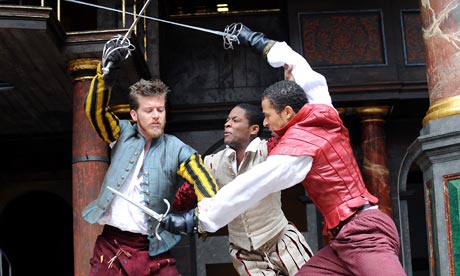
Romeo & Juliet at the Globe
ArtsHub:
“There is simply no reason to spend a night at the Globe this summer…”
“It is very difficult not to fall in love with Adetomiwa Edun’s Charismatic, glowing Romeo…”
The londonist:
“We missed the bubbling tribal tensions that fuel this play. We missed the Queen Mab speech: good as he is, Philip Cumbus' Mercutio didn't use the whole stage, and vocal projection remains a perennial Globe problem. We missed any tragedy. Worst of all, we missed a suitable Juliet.”
Thursday, 14 May 2009
British Museum
The year 2000 marked the completion of the reconstruction of the Great Court of the British Museum. The formal opening of the Queen Elizabeth II Great court was conducted by Her Majesty the Queen on December 6, 2000. The Reading room stands at the center of the courtyard encircled by two grand staircases leading to the Joseph Hotung Great Court Gallery and the Court Restaurant. The inner courtyard is enclosed by a magnificent glass and steel roof which transforms the space and adds a contemporary twist to the Roman-inspired architecture. Upon entering the Great Court, my eyes were automatically drawn upwards to the glass roof. The combination of steel framing, glass panels and geometric shapes reminded me of the Pyramids at the Louvre, though the Pyramids had diamond-shaped glass panels while these were triangular. From the eggshell walls to the glass ceiling, all these different design elements
Displayed in the Asia room is the Shiva Nataraja. In Hindu belief, Shiva manifests five aspects of eternal energy: creation, preservation, destruction, concealment, favor. The bronze figure illustrates the Hindu god Shiva appearing as the Lord of the Dance in a ring of fire (representing cosmic activity), lifting his leg and balancing over the dwarf of ignorance, Apasmara. His long hair flows out as he performs his dance and nestled within it is the goddess Ganga. In his upper right hand he holds a double sided drum representing the primordial sound of creation. The upper left hand holds a flame, which signifies destruction. The opposing concepts in upper hands show the counterpoise of creation and destruction. He makes the gesture ‘have no fear’ and points to his raised left foot, symbolizing liberation.
Monday, 11 May 2009
The Bloomsbury group is a loose collection of writers, artists, and intellectuals that made the Bloomsbury area of London the center of its activities during the first half of the twentieth century. Their work deeply influenced literature, aesthetics, criticism, and economics as well as modern attitudes towards feminism, pacifism, and sexuality (wiki). The membership of the group is not clearly defined and members vary from source to source.
Members of the Bloomsbury group included:
- Adrian Stephen: Author and psychoanalyst. Married to Karin Castelloe. Brother of Virginia Woolf, Vanessa Bell and Thoby Stephen.
- Bertrand Russell: Philosopher and campaigner for peace.
- Clive Bell: Art critic. Married to Vanessa Bell.
- David Garnett: Writer. Lover of Duncan Grant, husband of Anelica Garnett.
- Desmond MacCarthy: Journalist and editor.
- Dora Carrington: Artist.
- Duncan Grant: Artist.
- E.M. Forster: Writer (novelist).
- Gerald Brenan: Writer.
- Helen Anrep: Bloomsbury supporter. Long-term partner of Roger Fry.
- John Maynard Keynes: Economist. Key Bloomsbury supporter.
- Karin Costelloe Stephen: Philosophy graduate and expert on Bergson. Married to Adrian Stephen.
- Katherine Mansfield: Writer.
- Lady Ottoline Morrell: Literary hostess and patron of the arts. Lover of Bertrand Russell.
- Leonard Woolf: Writer and political figure. Founded Hogarth Press with Virginia Woolf. Married to Virginia Woolf.
- Lytton Strachey: Writer (biographer and essayist) and critic. Cousin of Ducan Grant.
- Mary Hutchinson: Writer and devoted patron of the arts. Clive Bell's lover.
- Molly MacCarthy: Writer.
- Roger Fry: Artist and critic.
- Saxon Sydney-Turner: Civil Servant.
- T.S.Eliot: Poet.
- Thoby Stephen: The Cambridge connection. Brother of Virginia Woolf, Vanessa Bell and Adrian Stephen.
- Vanessa (Stephen) Bell: Artist. Sister of Virginia Woolf, married to Clive Bell.
- Virginia (Stephan) Woolf: Novelist, essayist, biographer and critic. Founded Hogarth Press with Leonard Woolf. Sister of Vanessa Bell, married to Leonard Woolf.
- Vita Sackville-West: Writer (author and poet). Long time lover of Virginia Woolf.
- Wyndham Lewis: Painter and writer. Early associate of Roger Fry and Clive Bell.
ELIOT, T.S., OM (1888-1965),
Poet, lived and died here.
3 Kensington Court Gardens, W8
Kensington and Chelsea 1986
FORSTER, E.M. (1879-1970),
Novelist, lived here.
Arlington Park Mansions, Sutton Lane, Turnham Green, W4
Hounslow 1983
KEYNES, John Maynard (1883-1946),
Economist, lived here 1916-1946.
46 Gordon Square, Bloomsbury, WC1
Camden 1975
MANSFIELD, Katherine (1888-1923),
Writer, and her husband John Middleton MURRY (1889-1957), Critic, lived here.
17 East Heath Road, NW3
Camden 1969
MORRELL, Lady Ottoline (1873-1938),
Literary Hostess and Patron of the Arts, lived here.
10 Gower Street, WC1
Westminster 1984
RUSSELL, Bertrand (1872-1970)
Philosopher and Campaigner for Peace, lived here in flat no.34, 1911-1916
34 Russell Chambers, Bury Place, WC1
Camden 2002
SACKVLLE-WEST, Vita (1892-1962),
Writers and Gardeners, lived here.
182 Ebury Street, Belgravia, SW1
Westminster 1993
STEPHEN, Virginia (Virginia Woolf) (1882-1941),
Novelist and Critic, lived here 1907-1911.
29 Fitzroy Square, W1
Camden 1974
STRACHEY, Lytton (1880-1932),
Critic and Biographer, lived here.
51 Gordon Square, WC1
Camden 1971
WOOLF, Leonard and Virginia
lived in this house 1915-1924 and founded the Hogarth Press in 1917.
Hogath House, 34 Paradise Road
Richmond Upon Thames 1976
Thursday, 7 May 2009
The Photographers' Gallery
Alina Szapoczniko
Catherine Yass’ series Damage also caught my eyes. She treats her film transparencies according to their subject matter. She drowns, burns, and scratches the negatives of urban scenes using the subject as the inspiration for its destruction. I
Monday, 4 May 2009
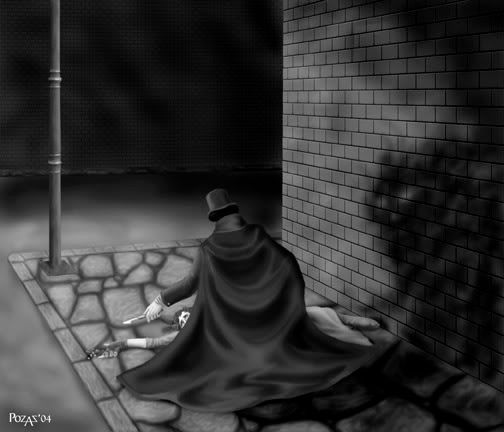
Jack the Ripper & the Victorian under class
Friday, 1 May 2009
Aesthetic & Tate Britain
What's your aesthetic?
When it comes to my aesthetic, I find it hard to pinpoint a particular world that I can be classified as. I enjoy a variety of art styles but if I must choose one I would have to say I am closest to being a classicist. I like looking for balance and harmony within art. Whether it’s a combination of light and shadow, sharp and faded, or deep and bright tones, I enjoy pieces that have a balance of opposite features. I also find that I have a tendency to gravitate more towards pieces that focus more on nature and landscapes. Though I’m not the biggest nature person, this style of art seems to affect my mood more so than other art forms.
Turner vs. Rothko
In the Turner/Rothko exhibit, I found Turner’s work to be of greater interest. In his earlier work Turner’s style appeared to be closely related to that of Rothko. They both created
very abstract pieces and their brush techniques appear to be very similar. However, I found Rothko’s pieces to be more abstract in that there isn’t any type of indication of what the pieces is suppose to be or what it is representing. On the other hand, Turner’s abstract pieces had subtle clues (such as his use of certain color combinations) that help the audience visualize what he was portraying in the pieces. It seems that Rothko’s art style remained the same while Turner went through many phases in his lifetime. As you walk through the different rooms, you can see the changes his painting style over
the years, It appears that over time Turner began to incorporate the use of lighting effects and more details into his work. The techniques used are so different that it’s hard to believe that all of the pieces were created by the same artist.
When it comes to my aesthetic, I find it hard to pinpoint a particular world that I can be classified as. I enjoy a variety of art styles but if I must choose one I would have to say I am closest to being a classicist. I like looking for balance and harmony within art. Whether it’s a combination of light and shadow, sharp and faded, or deep and bright tones, I enjoy pieces that have a balance of opposite features. I also find that I have a tendency to gravitate more towards pieces that focus more on nature and landscapes. Though I’m not the biggest nature person, this style of art seems to affect my mood more so than other art forms.
Turner vs. Rothko
In the Turner/Rothko exhibit, I found Turner’s work to be of greater interest. In his earlier work Turner’s style appeared to be closely related to that of Rothko. They both created
Subscribe to:
Posts (Atom)